Benthic Invertebrates Report
Introduction
Benthic monitoring conducted by the California Department of Water Resources (DWR) since 1975 has documented changes in the composition, density, and distribution of the macrobenthic biota inhabiting the upper San Francisco Estuary. This monitoring is performed by the Environmental Monitoring Program (EMP) as part of the Interagency Ecological Program (IEP) and is one component of the biological monitoring mandated by Water Right Decision D-1641. Since benthic species respond to changes in physical factors such as freshwater inflows, salinity, and substrate composition, benthic community data provides an indication of physical changes occurring within the Estuary. Benthic monitoring is an important component of the EMP because operation of the State Water Project can change the Estuary’s flow characteristics, affecting the density and distribution of benthic biota. Benthic monitoring data is also used to detect and document the presence of new, non-native species in the Upper Estuary, such as the 1986 arrival and subsequent wide spread of the overbite clam, Potamocorbula amurensis. This article summarizes benthic community characteristics at EMP monitoring sites in Water Year 2025 (October 1st 2024 through September 30th 2025) which was classified as a above normal year in the Sacramento and San Joaquin Valleys (source). It contextualizes these observations using community data from the preceding decade.
Methods
Benthic monitoring was conducted monthly at 10 sampling sites distributed throughout the Estuary, from San Pablo Bay upstream through the Sacramento-San Joaquin Delta (Figure 1; Table 1). EMP staff collected four bottom grab samples at each station using a Ponar dredge with a sampling area of 0.052 m2. The four replicate grab samples were analyzed for benthic macrofauna by Logical Zoology, a private laboratory under contract with DWR. All organisms were identified to the lowest taxon possible and enumerated.
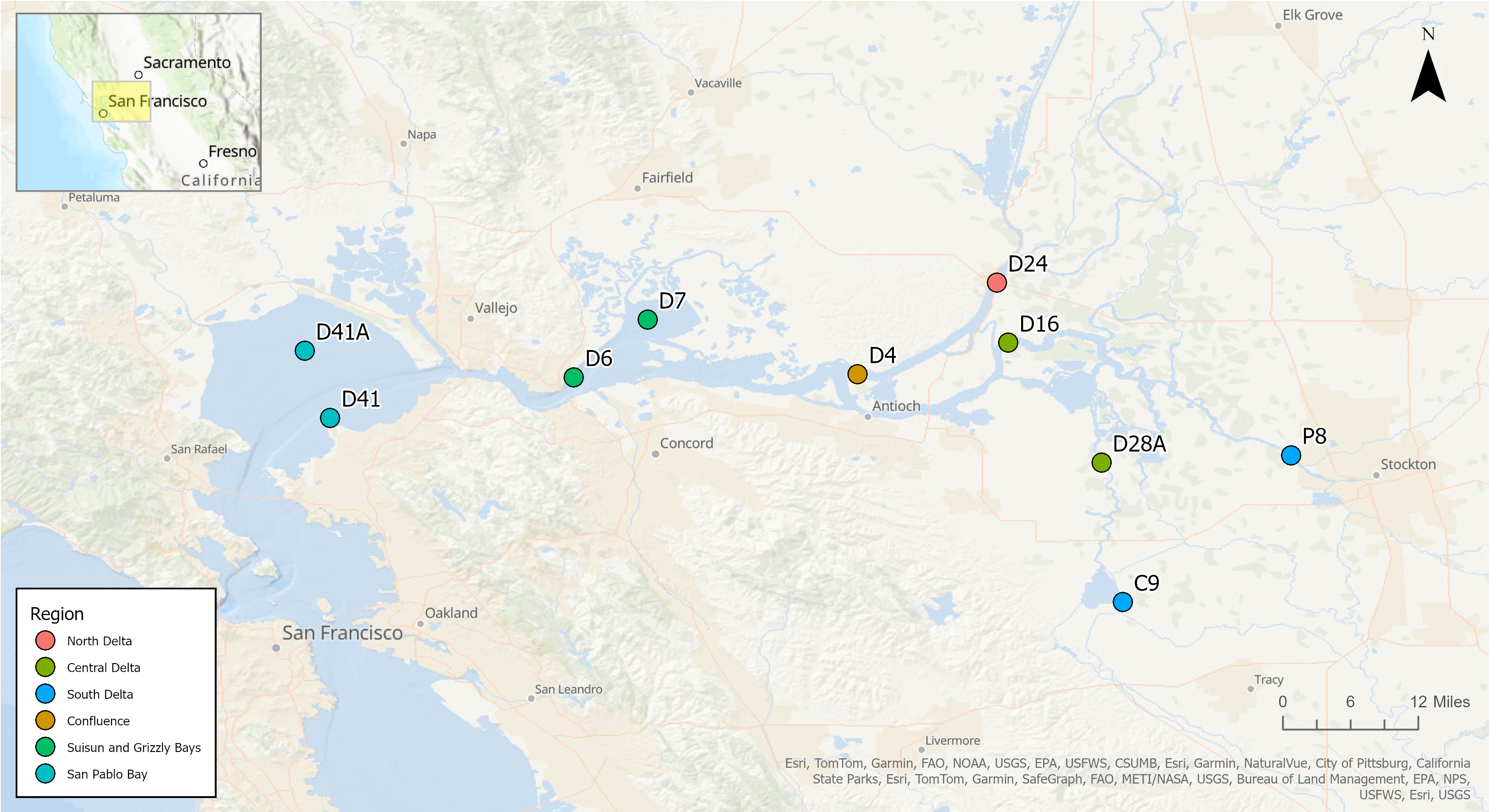
| Region | WY Index | Stations |
|---|---|---|
| North Delta | Sacramento | D24 |
| Central Delta | San Joaquin | D16, D28A |
| South Delta | San Joaquin | C9, P8 |
| Confluence | Sacramento | D4 |
| Suisun and Grizzly Bays | Sacramento | D6, D7 |
| San Pablo Bay | Sacramento | D41, D41A |
The 10 most common species were determined by summing the total organism counts at all stations and months for each species. For the bar graphs, the data is reported as the average organism catch per unit effort (CPUE). This was calculated as the organism count per replicate grab, converted to organisms per m2 (each grab is 0.052m2), averaged across replicates for each station in each month and aggregated by phylum.
Field collection methodology and laboratory analysis of benthic macroinvertebrates are described in detail in the benthic metadata found here.
Overall Results
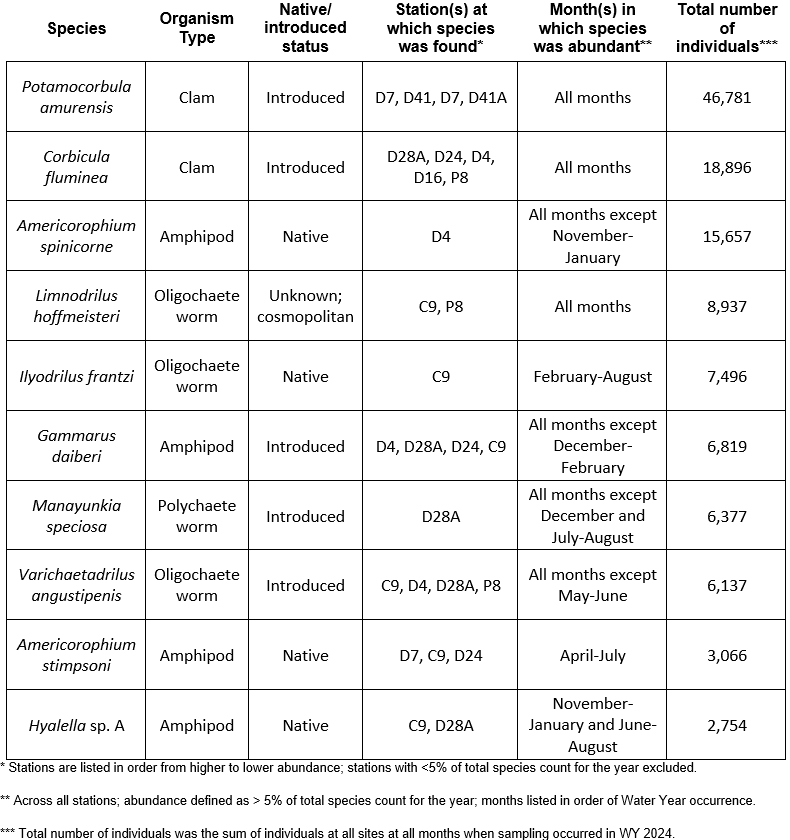
The benthic fauna collected in WY 2025 comprised 171 species across ten phyla: Arthropoda (42% of total organisms), Mollusca (39%) and Annelida (18%), with Nematoda, Phoronida, Cnidaria, Platyhelminthes, Chordata, Nemertea, and Echinodermata together representing a little over 1% of total organisms. Of the 171 benthic species collected in WY 2025, the ten most abundant species represented almost 83% of all individuals collected throughout the year (Figure 2). These include four species of amphipod, two clams, two oligochate worms, one polychate worm, and one small ostracod arthropod. Only one species in this group (the amphipod Americorophium spinicorne) is known to be native to this estuary. The rest of the top ten species are non-native or are cosmopolitan species of unknown origin. Refer to Fields and Messer (1999) for descriptions of the habitat requirements, physical attributes, and feeding methods of many of these species.
In the site descriptions that follow, most species densities are reported as the annual densities of individuals/m2, sometimes noting dramatic seasonal peaks. Some species, especially arthropods, display strong seasonal variability with peak monthly densities several times higher than their annual densities. In these cases, we reported the time and magnitude of the peaks as well as the annual densities. Please note that in March 2025, stations D6, D41, and D41A were not sampled due to high wind causing unsafe sampling conditions. Due to missing this month, comparisons to other years’ average annual densities or seasonal patterns should take this omission into account. Readers who wish to see the full dataset and its associated metadata can access it here.
Regional Results
North Delta (D24)
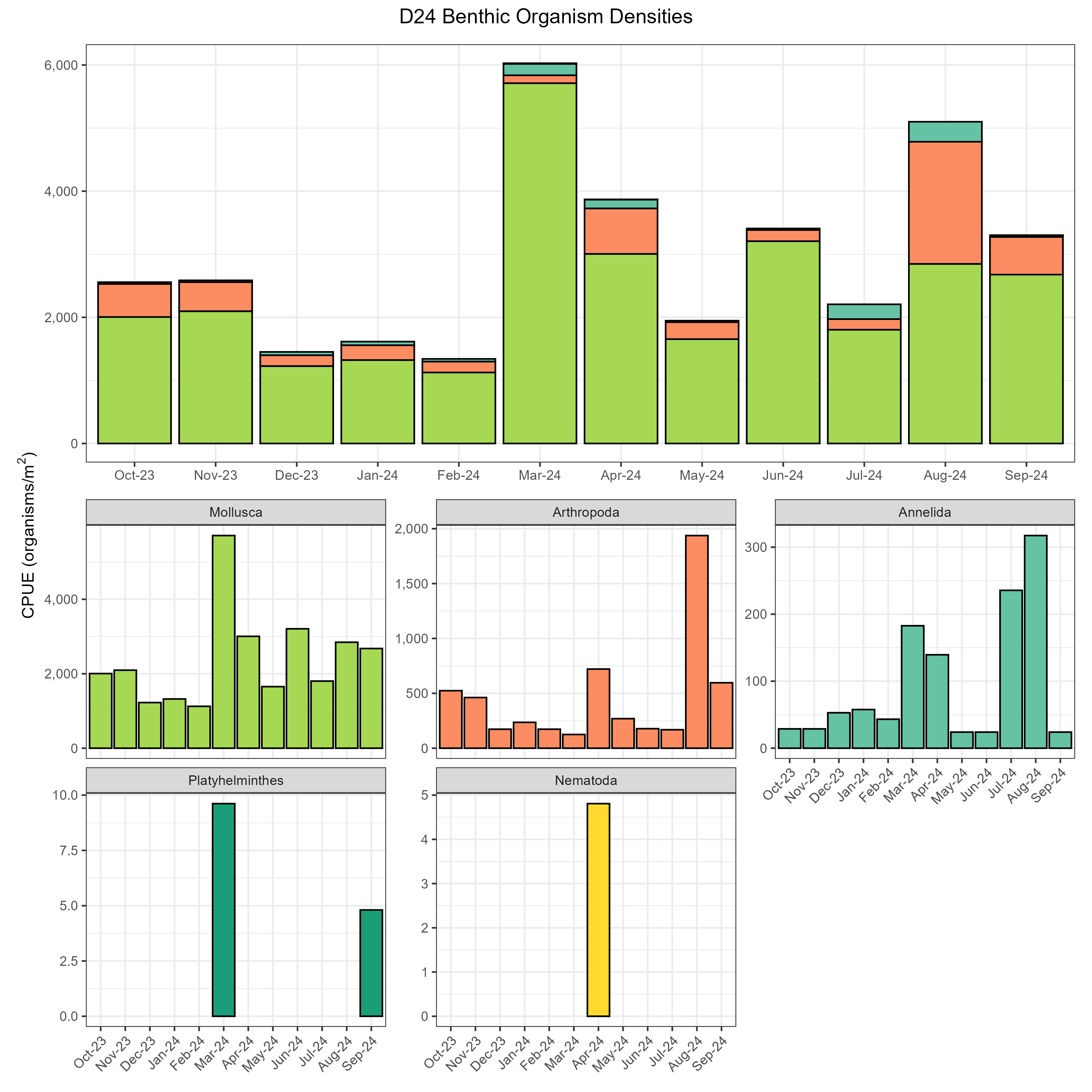
Site D24 is located on the Sacramento River, just south of the Rio Vista Bridge (Figure 1). There were 38 species in four phyla at D24 in WY 2025. Mollusca was the most abundant phylum for much of the year and made up 77% of all organisms collected at the station (Figure 3). Most of those mollusks (72% of all organisms) found at D24 in WY 2025 were the non-native clam Corbicula fluminea, with an annual average density of 1,391 individuals/m2. Corbicula fluminea density in 2025 was on the low end of the last decade, substantially lower than the high in 2018 of 3,484 individuals/m2. The second most abundant organism was the non-native amphipod Gammarus daiberi with a WY annual density of 176 individuals/m2, most of which appeared in a September 2025 peak of 913 individuals/m2. Otherwise, the composition of the community at D24 in 2024 was similar to other years in the last decade.
Central Delta (D16, D28A)
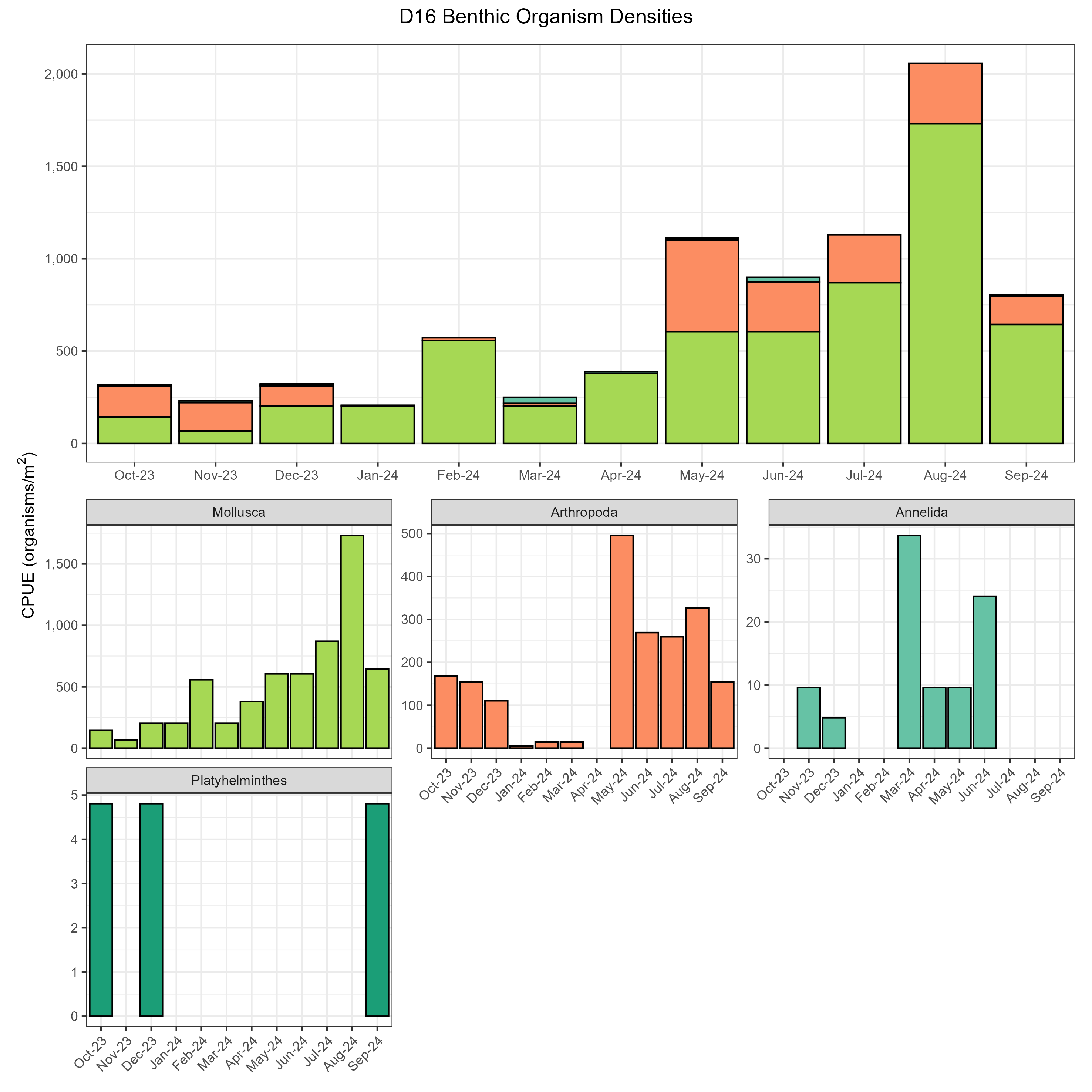
The benthic monitoring program sampled at two stations, in the Central Delta, D16 and D28. Site D16 is on the lower San Joaquin River near Twitchell Island (Figure 1). There were 20 species in five phyla at D16 in WY 2025, split largely between Mollusca (74% of all organisms collected in WY 2025) and Arthropoda (21%) (Figure 4). The most abundant species at D16 was the clam Corbicula fluminea which accounted for 72% of all organisms in 2025. The amphipod Gammarus daiberi was the second most abundant organism, accounting for 14% of all individuals, with an average annual density of 58 individuals/m2 and a peak in December 2024. Also notable was the August-September peak of the non-biting midge Demicryptochironomus sp, which topped out in September 2025 at 91 individuals/m2. Much of the rest of the community was a combination of various species of amphipods, insect larvae, and snails at lower densities. The total number of organisms at D16 in WY 2025 continued the trend of very low numbers compared with other years in the previous decade. In particular, WY 2020-2025 saw very low numbers of the amphipods Americorophium spinicorne and Americorophium stimpsoni, which were last seen in very high numbers at D16 from 2015-2018. One exception to this trend was Corbicula fluminea, which was at its second highest level in the last decade.
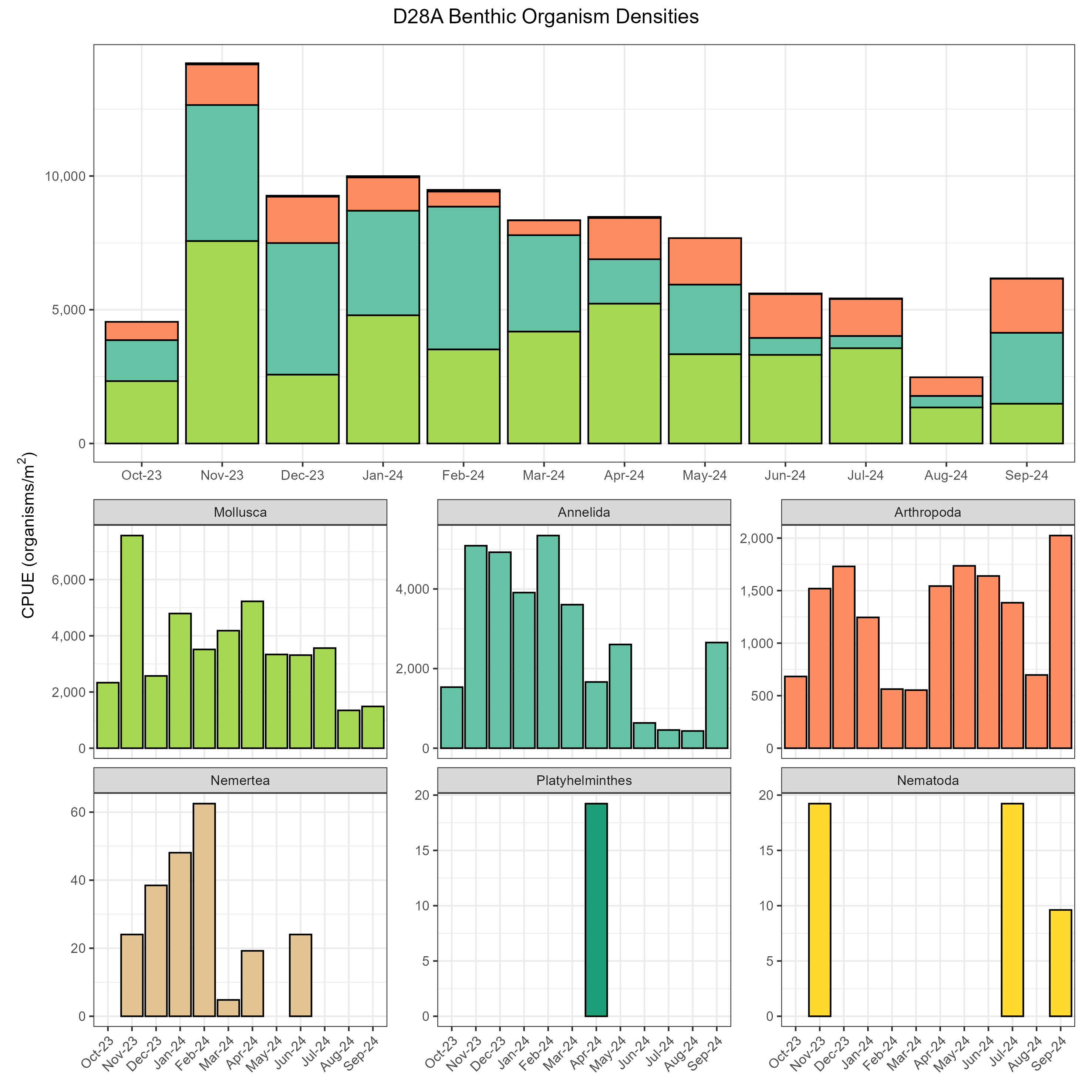
The site on Old River near Rancho Del Rio is known as D28A (Figure 1). In WY 2025, there were 51 species in five phyla at D28A. The most abundant phylum was Arthropoda, followed by Annelida and Mollusca (43%, 37%, and 21% of all organisms, respectively) (Figure 5). The most abundant species was the Asian clam Corbicula fluminea with an average density of 1,909 individuals/m2, followed by the sabellid worm Manayunkia speciosa with an average density of 1,855 individuals/m2 and higher densities between December and January 2025. Site D28A had an average number of total organisms in WY 2025 but the lowest number of total species seen in the last decade. A few notable features of WY 2025 compared to the last decade were the continued high densities of the snail Melanoides tuberculata, and the oligochaete worm Aulodrilus japonicus, along with a simultaneous strong decrease in the levels of the oligochaete worms Varichaetadrilus angustipenis and Limnodrilus hoffmeisteri to their lowest levels in a decade.
South Delta (P8, C9)
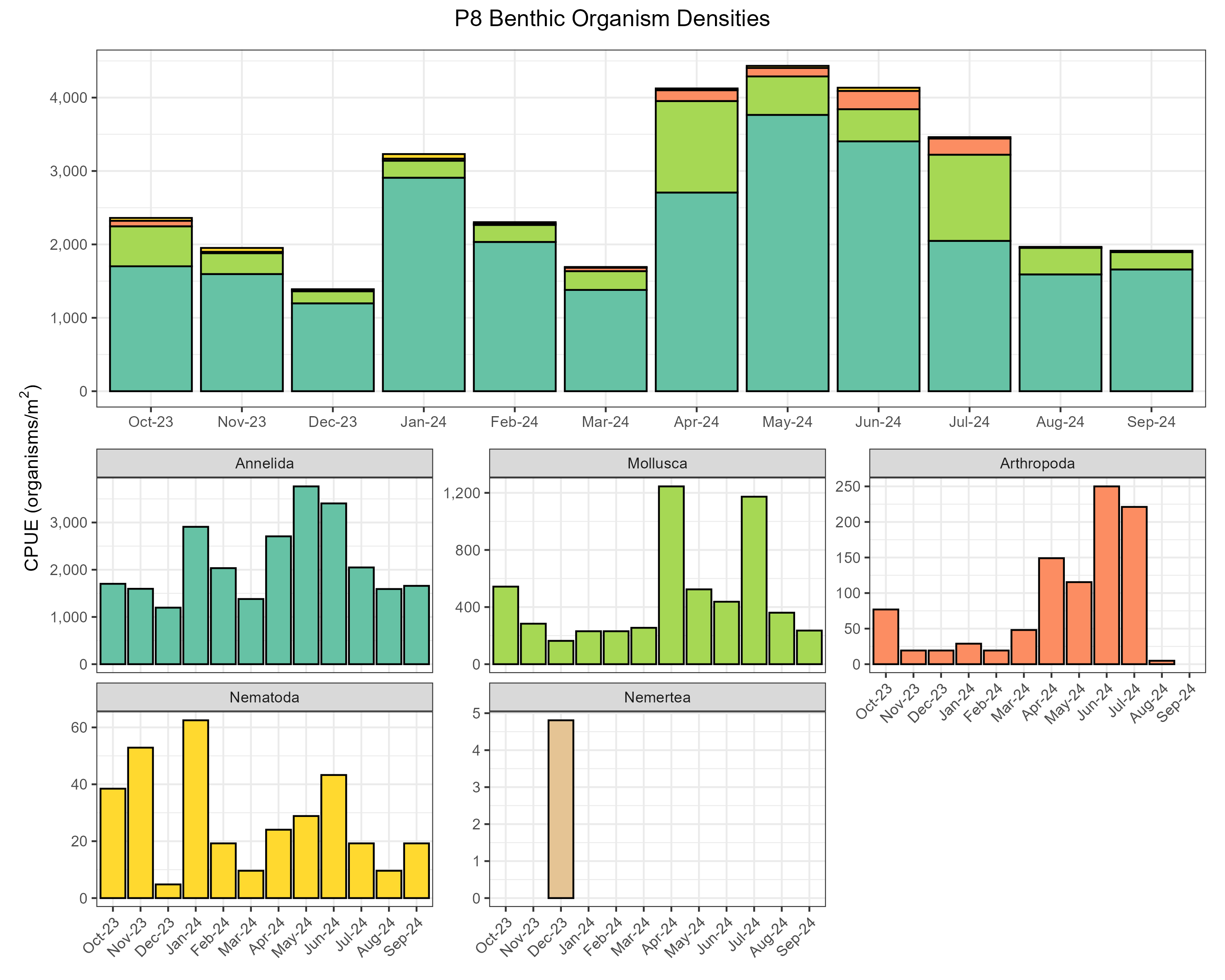
The benthic monitoring program sampled at two stations in the South Delta. Site P8 is on the San Joaquin River at Buckley Cove (Figure 1). Station P8 had a total of 44 species in five phyla in WY 2025. Annelida was by far the most abundant phyla at this station, accounting for 69% of all organisms collected (Figure 6). The dominant species were the oligochate worms Varichaetadrilus angustipenis and Limnodrilus hoffmeisteri (annual averages of 776 and 479 individuals/m2, respectively), followed by the clam Corbicula fluminea (459 individuals/m2). Another oligochaete worm, Branchiura sowerbyi had an annual average of 294 individuals/m2, and rounding out the top five species, for the first time, was the invasive golden mussel Limnoperna fortunei. While Limnoperna fortunei saw a dramatic increase in 2025, peaking in July at 764 individuals/m2, both Limnodrilus hoffmeisteri and Manayunkia speciosa in WY 2025 decreased dramatically from their high densities earlier in the decade, which peaked at 1,644 individuals/m2 in WY 2022 for L. hoffmeisteri, and 11,705 individuals/m2 in WY 2016 for M. speciosa. This site’s community composition is fairly consistent throughout the year and, apart from the dramatic arrival of Limnoperna fortunei, has remained largely unchanged through the last decade.
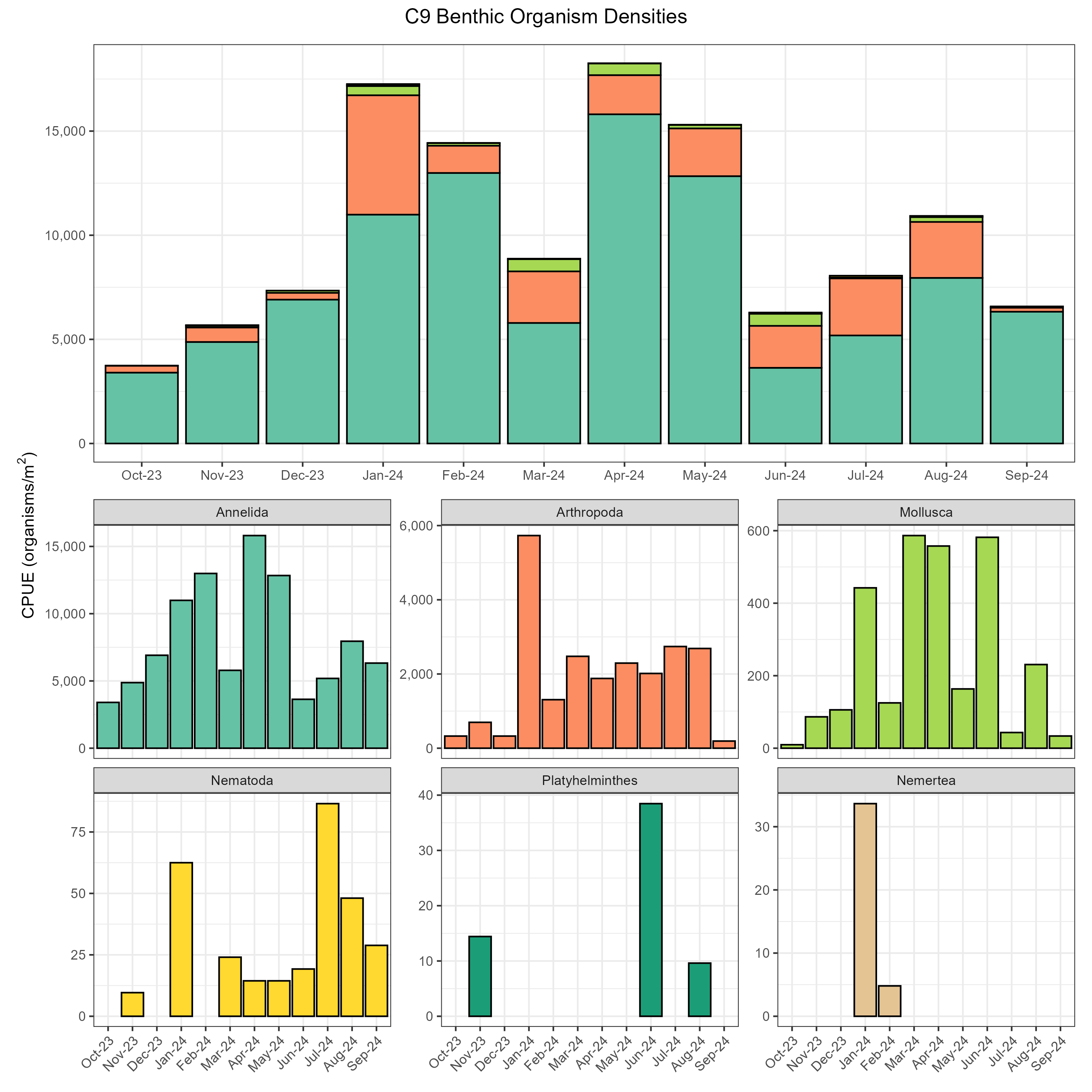
Site C9 is on Old River at the Clifton Court Forebay intake (Figure 1). There were 79 species in six phyla at C9 in WY 2025, the most diverse site we sampled. Annelida was the dominant phylum throughout the year, accounting for 56% of all organisms collected in WY 2025, followed by 29% Arthropoda. (Figure 7). Two oligochaete worms, Variachaetadrilus angustipenis and Limnodrilus hoffmeisteri, made up 22% and 17% of all organisms respectively. Variachaetadrilus angustipenis had an annual average of 1,784 individuals/m2 and was found throughout most of the year, while Limnodrilus hoffmeister’s annual average of 1,63 individuals/m2 were found mostly between October 2024 and February 2025. Site C9 also had highest diversity of aquatic insect larvae at any site sampled (24 species in WY 2025, mostly chironomid midges). The community was dominated by oligochaetes and has had similar overall composition for many years.
Confluence (D4)
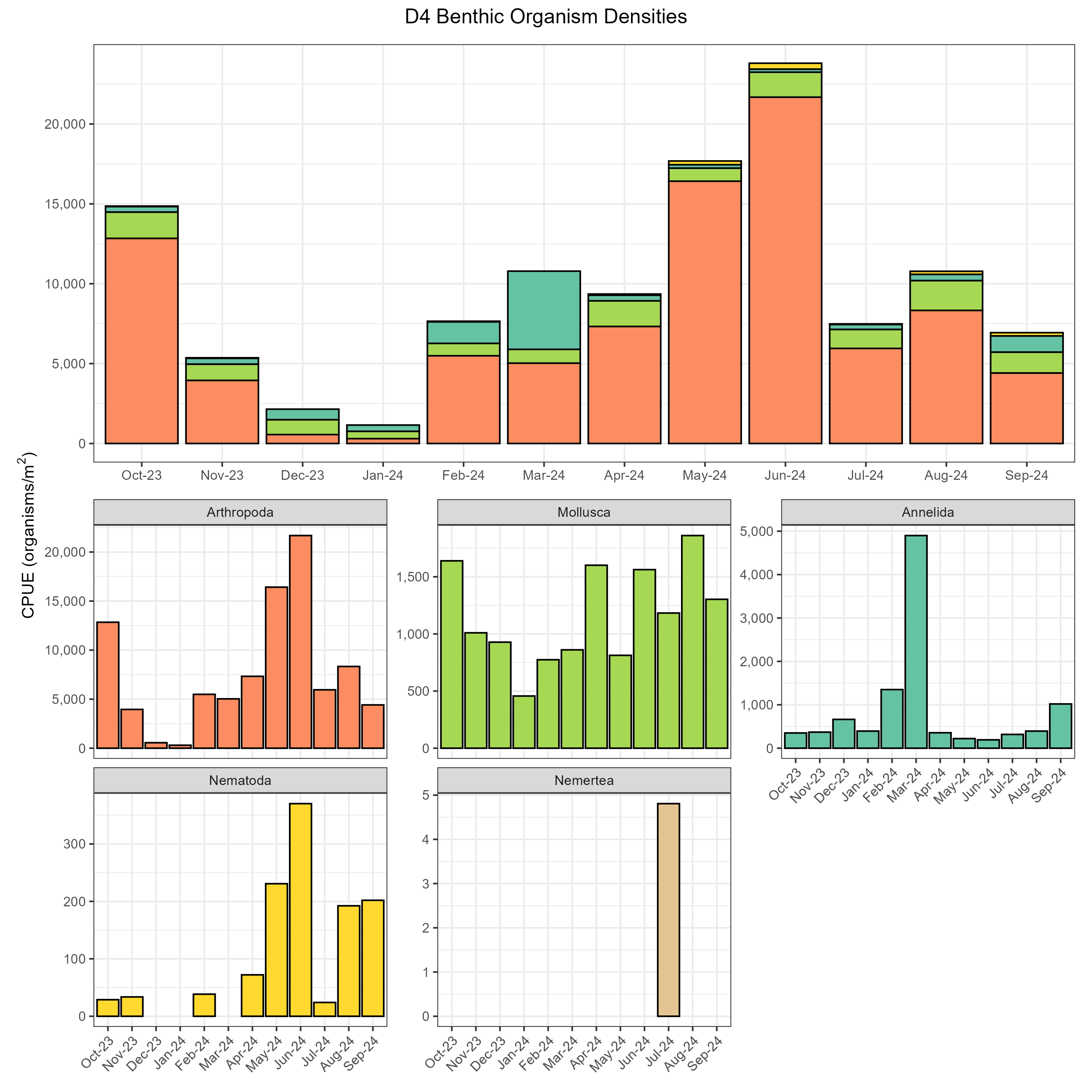
Site D4 is located near the confluence of the Sacramento and San Joaquin Rivers, just north of Point Sacramento (Figure 1). There were 37 species in six phyla at D4, of which Arthropoda was the most abundant (84% of all organisms) followed by Mollusca and Annelida (each with 8% of all organisms) (Figure 8). The native amphipod Americorophium spinicorne was the most abundant species at this station and made up 65% of all individual organisms in WY 2025 with a seasonal increase between May and August , peaking in July at 28,375 individuals/m2, with an annual average of 6,962 individuals/m2. The non-native amphipod Gammarus daiberi had an annual average of 1,440 individuals/m2, which had a marked seasonal increase from May-September and a peak in July of 4,240individuals/m2. The invasive clam Corbicula fluminea had a steady year-round average (except for a low in January) of 833 individuals/m2, while the polychaete worm Laonome calida had a dramatic peak in January of 1,942 individuals/m2 and lower densities much of the rest of the year.
Because of D4’s position at the front of saltwater and freshwater mixing in the estuary, we often see a shift from the freshwater clam Corbicula fluminea to more brackish-waterPotamocorbula amurensis following dry years, and the reverse following wet years. The drought of 2018-2022 led to high Potamocorbula numbers, which abruptly crashed down in WY 2023 and 2024 while Corbicula increased strongly in both those years. WY 2025 was also notable for the continued rebound of amphipods Americorophium spinicorne and Gammarus daiberi in WY 2025 from their lows in WY 2022, and the dramatic continued drop of oligochaetes Limnodrilus hoffmeisteri and Variachaetadrilus angustipenis from their decade highs in 2017.
Suisun & Grizzly Bays (D6, D7)
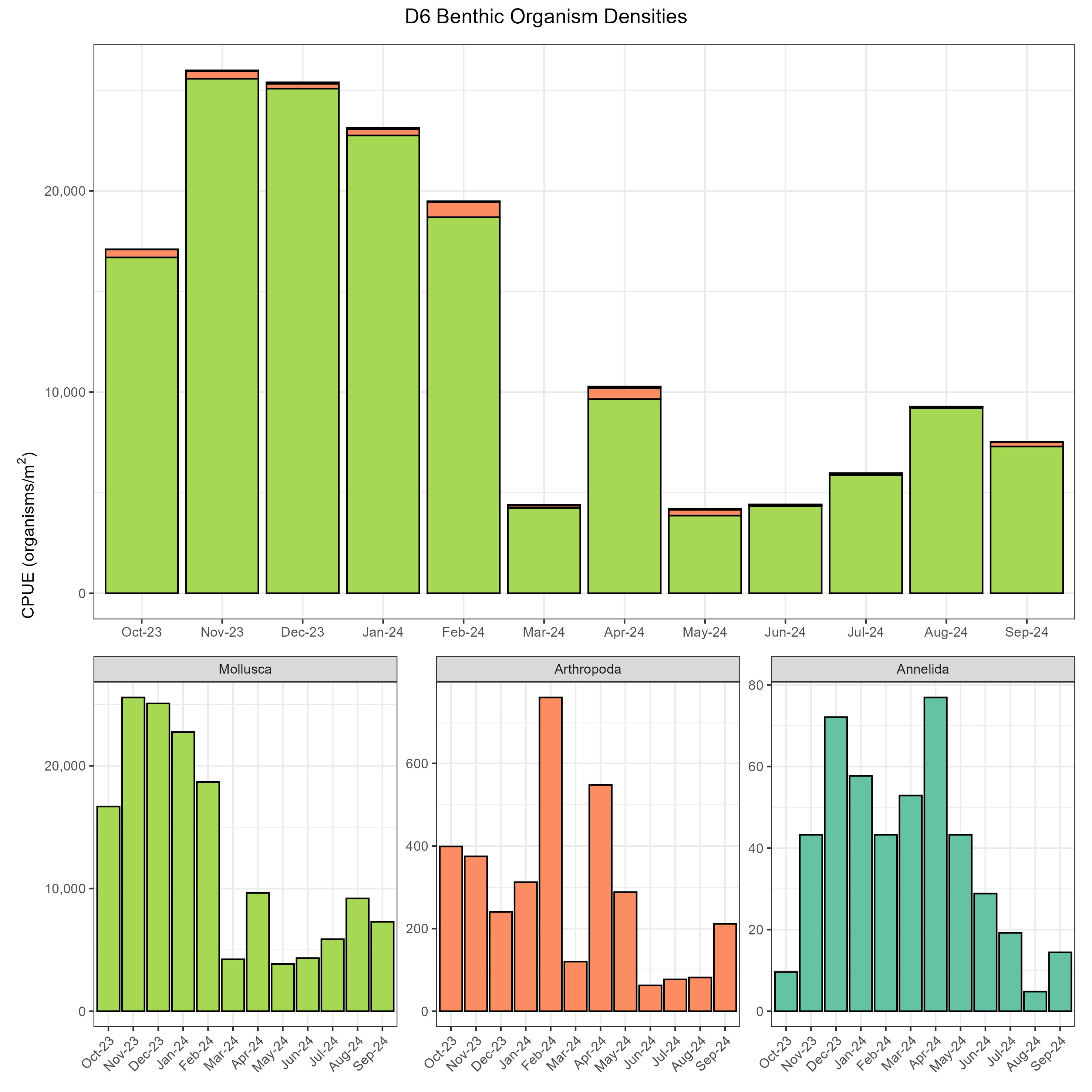
The benthic monitoring program sampled at two stations in the Suisun Bay area, D6 and D7. Site D6 is in Suisun Bay near the I-680 bridge (Figure 1) and had 20 species in three phyla in WY 2025. Mollusca was the dominant phylum, accounting for 98% of all organisms collected (Figure 9). Most of the organisms collected (98%) were the invasive Asian clam Potamocorbula amurensis, which had an annual density of 6,178 individuals/m2. Potamocorbula amurensis densities were low from March through June 2025 but relatively high in all other months. The relatively few other organisms found at this site were predominately from phylum Arthropoda, primarily the isopod Synidotea laevidorsalis, the brackish-water bay barnacle Amphibalanus improvisus, found mostly growing on P. amurensis shells, or the cumacean crustacean Nippoleucon hinumensis. All were found at much lower densities than Potamocorbula amurensis.
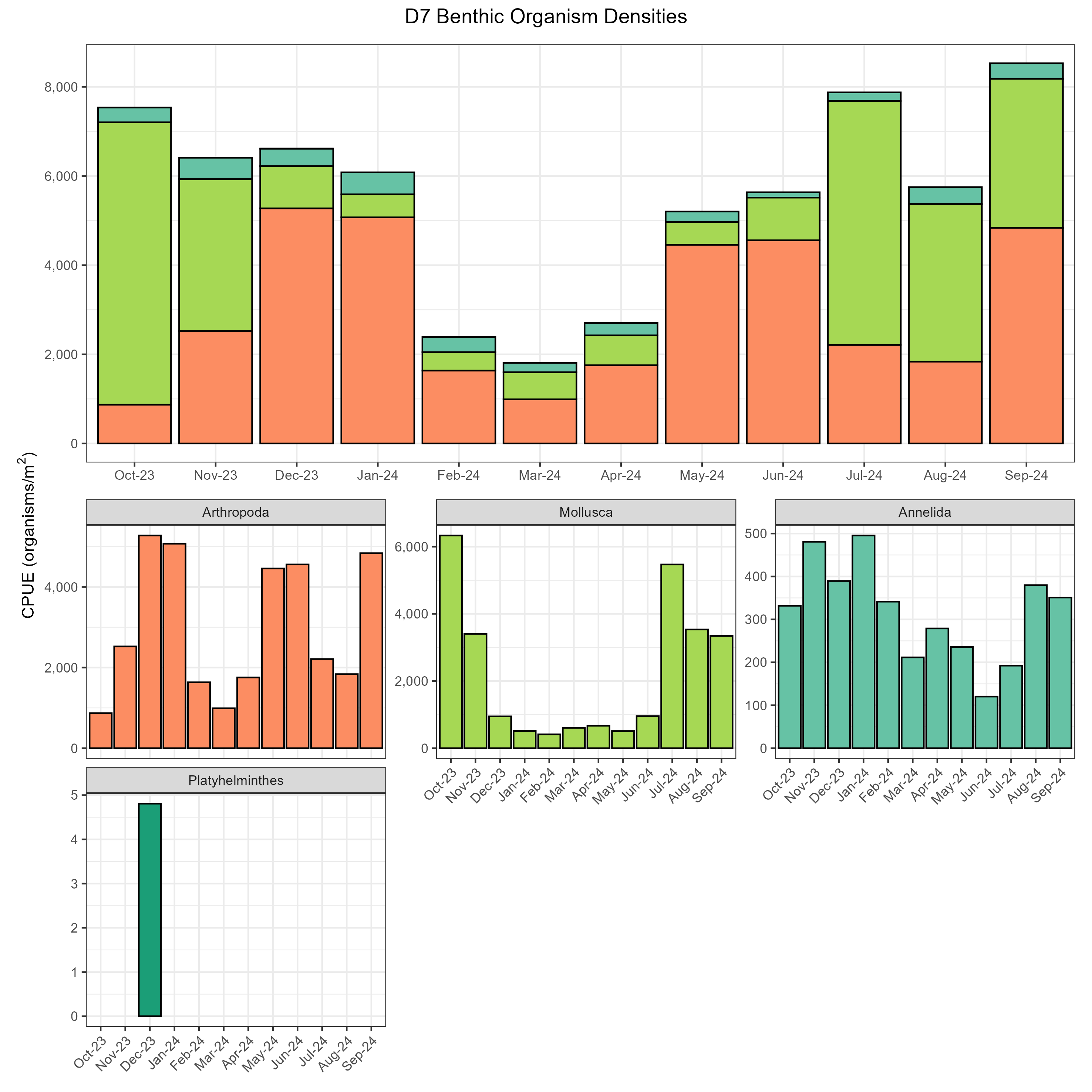
Site D7 is in Grizzly Bay, near the entrance to Suisun Slough (Figure 1). There were 24 species in three phyla in WY 2025. Mollusca comprised 52% of the total organisms, Arthropoda 44%, and Annelida the remaining 3% (Figure 10). The non-native clam Potamocorbula amurensis had an annual average of 4,897 individuals/m2 and was most common in June-September 2025. While P. amurensis has been numerically dominant through the last decade, a major change in WY 2022 meant its annual densities since then are a fraction of what they were in 2013-2015, and WY 2025 represents the first modest rebound from the lows of WY 2022-24. The amphipod Sinocorophium alienense (annual average 3,707 individuals/m2, mostly June-September 2024) was the next most numerous. The cumacean crustacean Nippoleucon hinumensis (141 individuals/m2, mostly October 2024-February 2025) and the oligochate worm Tubificoides heterochaetus (annual average of 141 individuals/m2, largely between December 2024 and May 2025) comprised the list of most dominant species. Potamocorbula amurensis, Sinocorophium alienense , and Tubificoides heterochaetus are all on the increase over the decade, with dips in density that include 2022 and 2023; this is the inverse pattern to Nippoleucon hinumensis, which saw decadal peaks in 2021-2022 and has been on the decrease since. The community in WY 2025 was similar overall to the species that have characterized it over the last decade.
San Pablo Bay (D41, D41A)
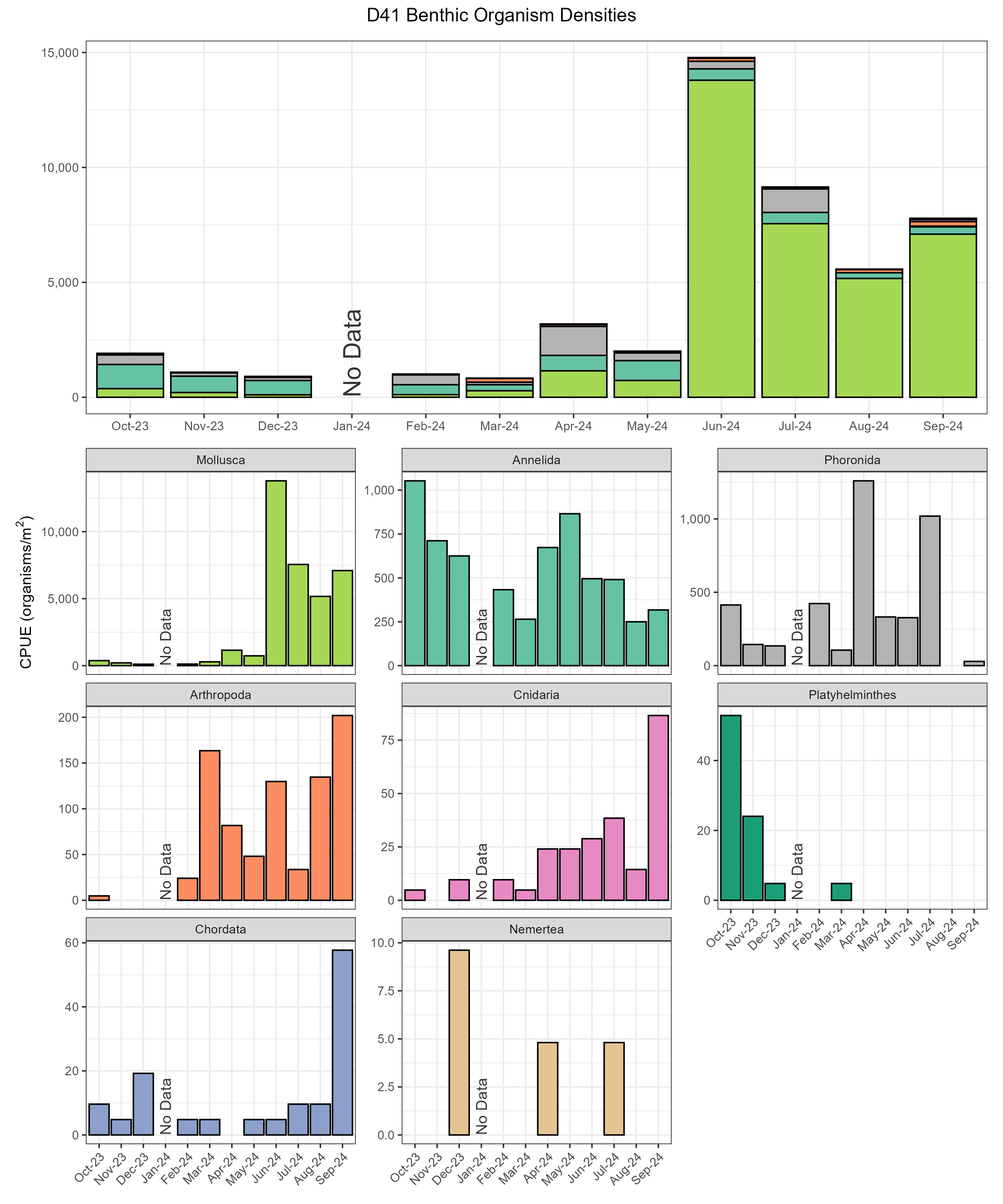
The benthic monitoring program sampled at two stations in San Pablo Bay, D41 and D41A. Station D41 is near Point Pinole (Figure 1) and has a benthic community primarily composed of marine organisms, especially in drier water years. There were 58 species in eight phyla at D41 in WY 2025. Mollusca was the most abundant phylum (70% of all organisms) followed by Arthropoda (17%), Annelida 7%), and Phoronida (5%) (Figure 11), a genus of tube-dwelling filter-feeders also known as horseshoe worms. The single most abundant species was the invasive clam Potamocorbula amurensis, which alone accounted for 67% of all organisms and had an average annual density of 2,993 individuals/m2, distinguished by a gradual decline over the winter from December 2024 into March 2025, followed by a sharp peak of recruitment in April 2025. The next most abundant organisms were the amphipod Ampelisca abdita and Phoronopsis harmeri, a native phoronid species. Almost all Ampelisca abdita was seen in August 2025, with a dramatic peak of 6,966 individuals/m2 only in that month. In contrast, Phoronopsis harmeri was present through much of the year, with an average annual abundance of 209 individuals/m2. While more marine genera such as Ampelisca and Phoronopsis were numerically dominant, they were much less dense in WY 2025 than in drier water years such as WY 2021. The continued high numbers of Potamocorbula amurensis, which prefers more brackish water, and the non-native mussel Musculista senhousia, which has broad salinity tolerances, may indicate the continued dominance of a more oligohaline community than seen in more marine-influenced drought years.
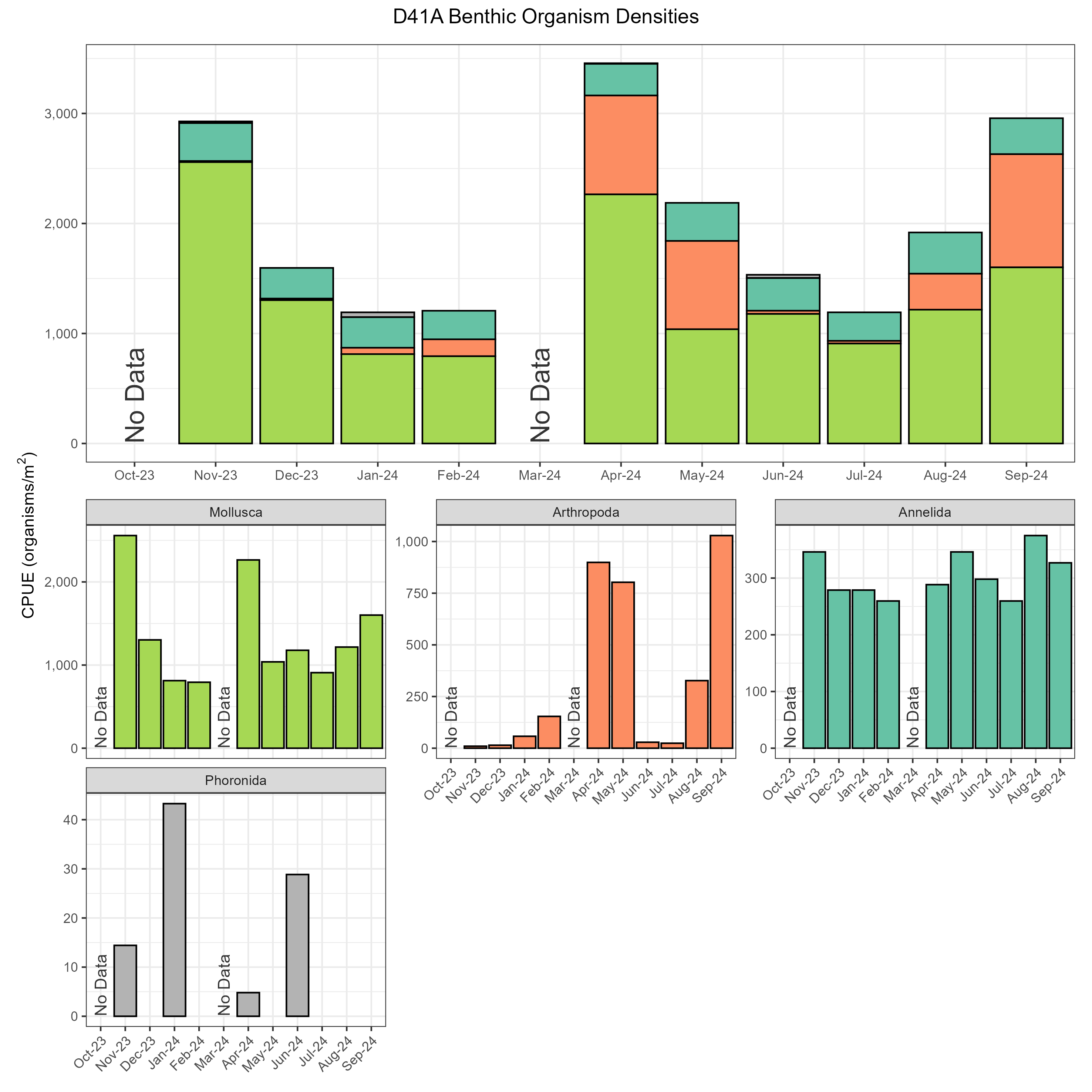
Station D41A is in San Pablo Bay near the mouth of the Petaluma River (Figure 1). There were 40 species in six phyla at D41A in WY 2025, relatively low in total diversity for the last decade at this station. The most abundant phyla was Arthopoda (63% of all organisms), with Mollusca second (37%) and Annelida third (4%) (Figure 12). The most numerous species was the amphipod Ampelisca abdita, which had an annual average density of 3,809 individuals/m2 with peaks in December 2024 and June 2025, followed by the clam Potamocorbula amurensis, which had an annual average of 2,056 individuals/m2 and a peak in April 2025, likely from seasonal recruitment. The small cumacean arthropod Nippoleucon hinumensis (275 individuals/m2) and the non-native mussel Musculista senhousia (133 individuals/m2) filled out the roster of most numerous organisms. While Ampelisca abdita was well below its high densities of drought years 2020 and 2021, it was up somewhat from WY 2024, and both Potamocorbula amurensis and Musculista senhousia were orders of magnitude higher than their very low densities of 2021-2023.
Interpretations
In summary, WY 2025 continued the trend of low average organism density begun in WY 2022. This trend was consistent across most sites, and was due in large part to the sharp dip in Annelida densities over the last decade, mostly via the decrease in the sabellid worm Manayunkia speciosa at Central Delta sites but also decreases in oligochaetes Variachaetadrilus angustipenis and Limnodrilus hoffmeisteri. All three of these worms of these are still in the top ten most numerous species in WY 2025, but have declined markedly since their very high densities in 2016-2017.
In addition, some total organism density declines were due to the the decade-long decrease in various amphipod species, especially Ampelisca abdita in San Pablo Bay, Sinocorophium alienense in Grizzly Bay, and Americorophium stimpsoni in fresh water. Since many fish species have switched to amphipod food sources after the collapse of mysid shrimps (Feyrer et al. 2003), the near disappearance of various amphipod species may have food web implications unless they have simply shifted their ranges out of our sampling area. The rallying in WY 2025 of Sinocorophium alienense in brackish regions signals a return of plentiful amphipods in the middle of the region, but, while Ampelisca abdita has increased at San Pablo Bay sites in the last year, it is still far lower than the high densities seen in 2018-2021.
Densities of the non-native clams Potamocorbula amurensis and Corbicula fluminea are low to moderate compared with the last decade, often reacting with a lag after extremely wet or dry water years. Depending on what kind of water year comes with the predicted extreme El Niño event of WY 2026, we may see an abrupt change to salinity regimes, which could shift the estuary position of their preferred salinity ranges and have large effect on recruitment patterns in the warm weather of 2026.
Our ability to recognize these changes over decadal timescales highlights the importance of continued monitoring of benthic invertebrates to a high taxonomic resolution across the entire estuarine salinity gradient, as the community interacts with both various abiotic conditions as well as key parts of the estuarine food web.
References
Fields W, Messer C. 1999. Life on the bottom: Trends in species composition of the IEP-DWR Benthic Monitoring Program. IEP Newsletter 12(4): 38-41.
Feyrer, F., B. Herbold, S. A. Matern and P. B. Moyle. 2003. Dietary shifts in a stressed fish assemblage: consequences of a bivalve invasion in the San Francisco Estuary. Environmental Biology of Fishes 67(3): 277-288.
Hartman, R., Twardochleb, L., Burdi, C. E., & Wells, E. H. (2024). Amazing Graze: Shifts in Jellyfish and Clam Distributions During Dry Years in the San Francisco Estuary. San Francisco Estuary and Watershed Science, 22(1). doi:https://doi.org/10.15447/sfews.2024v22iss1art4
Archived Reports
Previous EMP benthic reports can be found here.